

Data Desk
The GLP-1 Economy: Who's Winning the $226B Companion Market
 14 min read

Key insights
- The companion economy is projected to be worth 2x the drug market itself. $226B today, projected to hit $479B by 2033. 130+ brands are competing for a share of a conversation that didn’t exist four years ago.
- The brands winning it don’t market to it. Costco, Ulta, and Danone’s Oikos are three of the biggest beneficiaries of GLP-1 consumer behavior and none of them mention the drug in owned content. Creators carry the language. The brands take none of the risk.
- The loudest brands carry the most liability. Lemme is facing a class action over the exact “Natural GLP-1” claim that drove its engagement. The label itself is now under industry scrutiny. Proximity without the claim is the safer trade.
- The closer you sit to the prescription, the less your audience likes you. Telehealth brands average 72% net sentiment. Beauty averages 94%. Distribution is a sentiment tax; one that pricing and access decisions widen, regardless of celebrity endorsements.
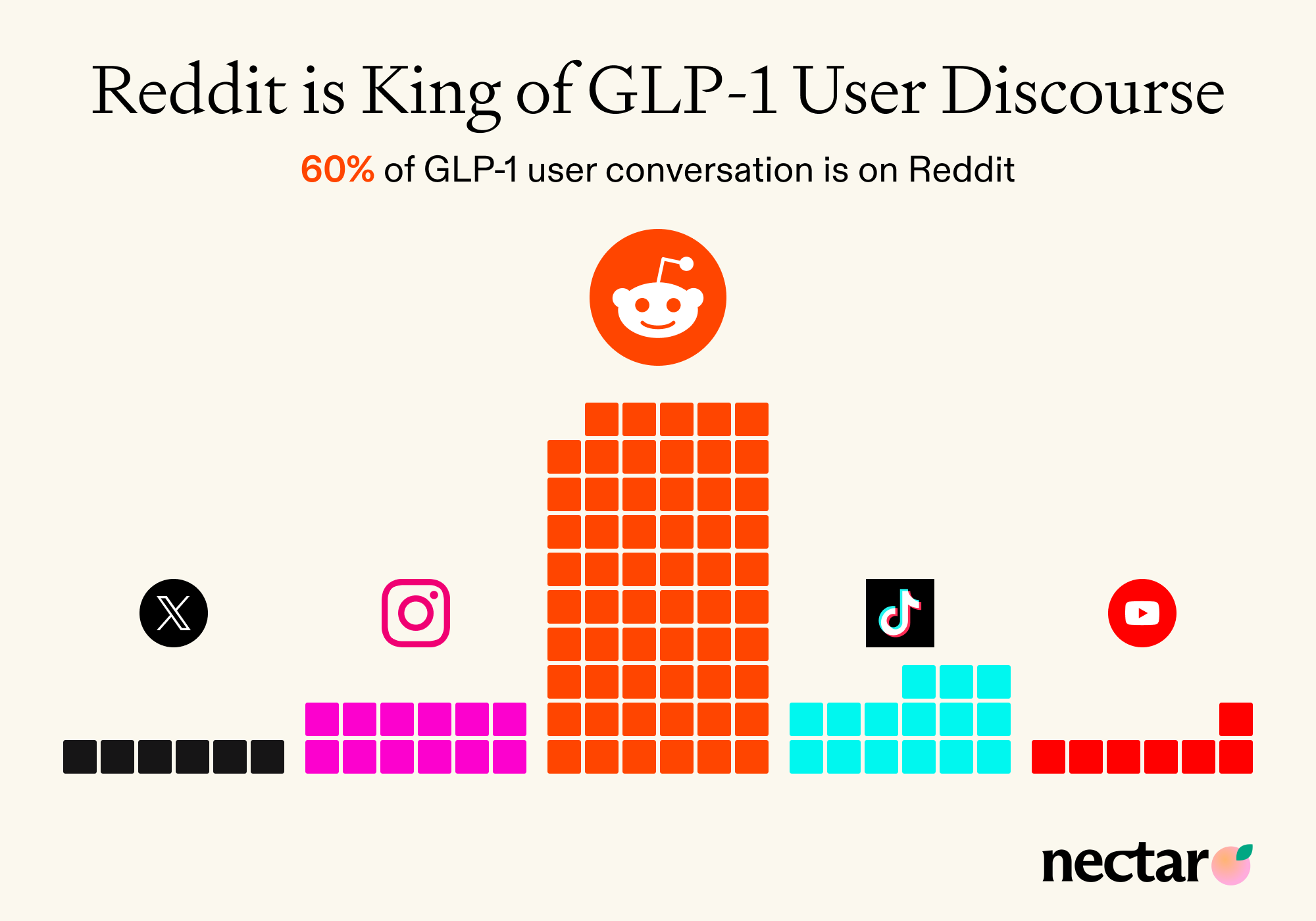
- Reddit is where the actual buyers are. 60% of first-person patient conversation lives on Reddit, a platform holding just 14% of total GLP-1 volume. TikTok is where GLP-1 users watch. Reddit is where they decide.
- A large white space is addressing the mental health side-effects of GLP-1s. “Ozempic personality” and the flattened-mood narrative has reached large organic audiences, and no consumer brand owns it. Mood, adaptogen, and mental-wellness players have a fully mainstream conversation waiting for a first-mover.
This report is for the CMOs, CPG & pharma operators, retail merchants, and telehealth marketers deciding right now whether and how their brand should participate in the GLP-1 conversation.
Introduction
15% of all American adults have taken a GLP-1, up from only 6% two years ago, a stark adoption curve. And it’s not slowing down, as an analysis by Morgan Stanley estimates that in the next ten years GLP-1 revenues will increase more than 200%, from $79B in 2025 to $240B in 2035.
A GLP-1 companion economy has risen to meet this change in consumer behavior. Today this companion economy is estimated to be ~$226B, growing to $479B by 2033, roughly double the value of the GLP-1 market’s projected size. To contextualize this size, the global revenue of the soda market is ~$459B.
Therefore, brands must ask if their customers’ needs are changing and if their products are keeping up.

Brands need to ask themselves this question because the GLP-1 economy is only gaining momentum. We’ve tracked brand entrances into the GLP-1 conversation since 2022, and the line still hasn’t flattened, and neither has the overall GLP-1 conversation. Food and beverage runs deepest, but no category has consolidated and no single brand has run away with the lion’s share of the market.
Yet despite this burgeoning GLP-1 economy, to our knowledge no one has published a large-scale, cross-platform analysis of how people are discussing these drugs on social media. There has been high-volume analysis of text-based content, and careful, low-volume work on TikTok and Instagram video content, but there hasn’t been both at once, applying the scale of the text-based research to all content formats.
Such an analysis is particularly important because GLP-1 users are social media power-users. Relative to the average American, GLP-1 users over-index on TikTok by 32 percentage points; 22 on Reddit, and 21 on Instagram. Therefore, a comprehensive, multi-platform analysis of social media conversation is not only filling a gap in the existing research, but also providing crucial consumer insights.
So we set out to do just that. Using Nectar’s multi-modal intelligence capabilities, we analyzed 369K posts from August 2025 to August 2026 across Reddit, Instagram, TikTok, YouTube, and X that generated 6B views and $2.5B in earned media value.
Who’s winning the companion economy (so far)
So which brands are winning the GLP-1 companion economy at this point? To find out, we analyzed how 130+ brands show up within GLP-1 online discourse and communities, measuring each on three axes: reach, engagement, and share of the GLP-1 conversation. Unlike our World Cup analysis, where winners were unmistakable, the GLP-1 companion economy has no runaway leader yet. It’s fragmented, competitive, and brands are winning (and losing) with very different strategies. The rest of this report is about which of those strategies are worth copying and learning from.
Cross industry takeaways
1. You don’t have to explicitly market yourself as GLP-1 friendly in order to own the conversation. In fact, many of the top brands we analyzed never position themselves as GLP-1 companion products at all.
Take Costco. Despite offering GLP-1 prescriptions and stocking companion products, none of Costco’s owned content mentions the drugs. Instead, creators carry it through formats like the GLP-1 shopping haul. One Costco essentials haul from a 12K-follower creator generated 255K views and 15K likes. Costco doesn’t make GLP-1 content and yet it is one of the top settings for it.
This kind of UGC engine is planned, not lucky. While Sephora phased out supplements, Ulta built dedicated wellness stands and locked a retail exclusive with Maelys, whose Toning Body Whip targets sagging skin after major weight loss. That shelf decision produced a 286K-view video of a creator buying the product to document her post-GLP-1 results. And like Costco, Ulta earned the attention without making the claim itself.
Nor is this limited to retailers. Danone’s yogurt president called GLP-1 users “the center of the bullseye” for their new product, Oikos Fusion, yet after the announcement post, Oikos never mentioned the drugs on owned socials again. This allows creators to own the GLP-1 language — and the risk that carries — through content formats like “what I eat in a day on a GLP-1” while the brand sells the outcome of increased protein intake to combat muscle loss.
As competitors race to print “GLP-1 friendly” on the box, an alternative position is to let creators own the GLP-1 language for you.
2. The closer your brand is to prescribing a GLP-1, the more negative your sentiment.
Telehealth brands (i.e. the ones actually distributing GLP-1s) post the lowest net sentiment of any category at 72%, compared to 94% for beauty, with retail, weight management, and supplements in the middle. Notably, this is not about keeping distance from the category: brands with explicitly GLP-1-branded products, like Supergut and Replenza, post some of the best net sentiment in the entire dataset at 99% and 97%.
Category takeaways and leaderboards
The brands performing best today are not automatically the brands to copy. Some advantages aren’t replicable on any reasonable timeline (Costco’s scale), and some aren’t desirable (Lemme’s legally-exposed claims). So for each category below, we’ve separated the two. The rankings show who owns the conversation right now, and the takeaways distill the lessons any brand can actually use. We present two to three lessons per category, each one grounded in what the data shows is working (and not working) today.
Keep reading this report
Supplements
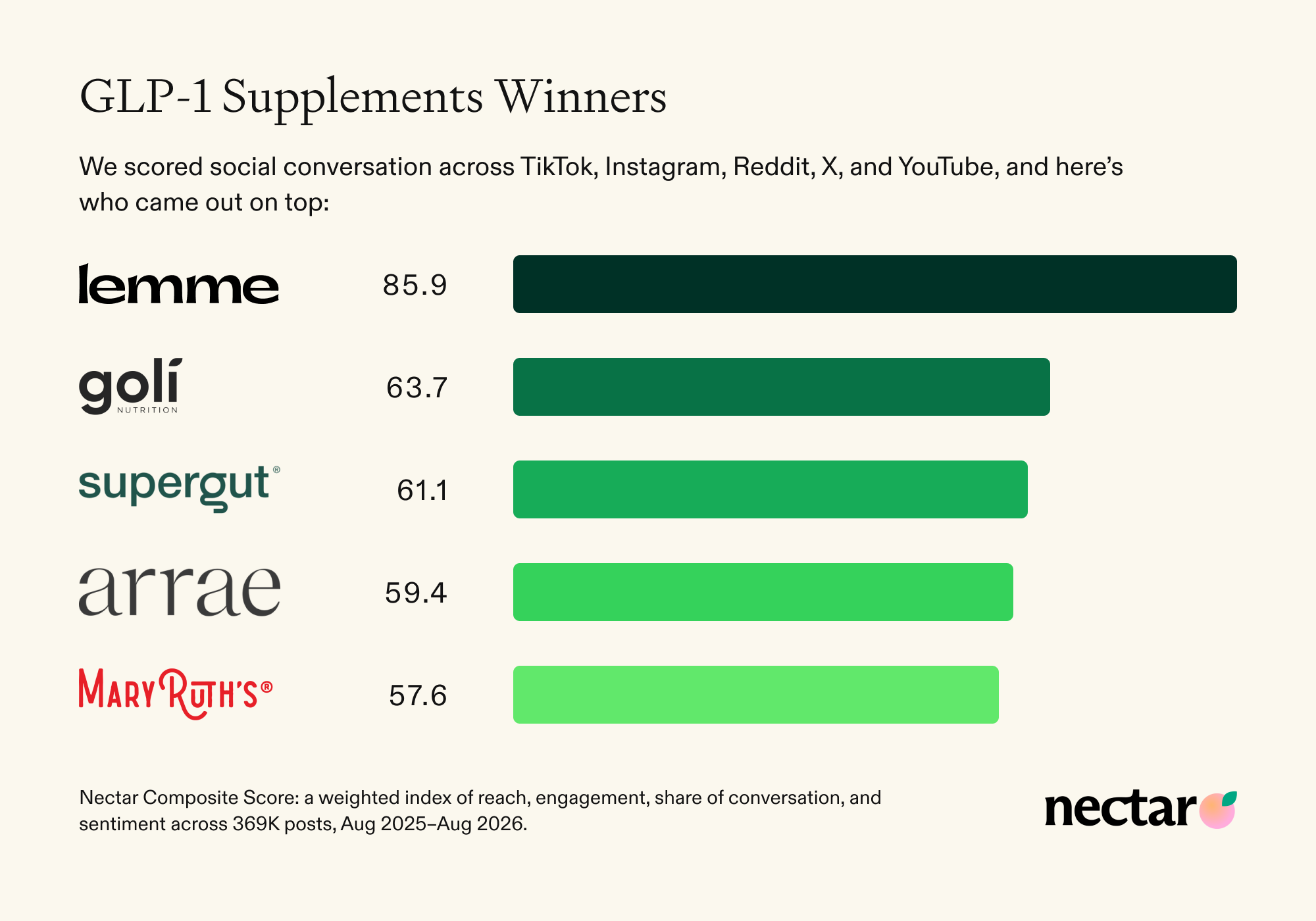
- Lemme wins the category on the numbers, but its playbook is not easily replicable: you can’t rent Kourtney Kardashian’s audience, and Lemme is facing a class action lawsuit over the exact GLP-1 claim that produced the engagement.
- Companionship beats mimicry or replacement. As GLP-1 insurance coverage expands and prices continue to drop, the drugs will keep becoming more accessible, with estimates that the number of Americans using them will increase by 2.5x by 2030. That trend cuts in opposite directions for the two strategies. Companion products (those addressing the side effects of a drug people are already taking) grow as adoption grows. In contrast, mimics (e.g. “Natural GLP-1”) sell to the access gap, which is closing, with increased legal exposure.
- A number of side effects are underserved. Sulfur burps, NAD depletion, and hair loss all carry organic UGC demand with no single credible brand winning them. Mary Ruth’s is showing signs of drafting off hair-loss demand. The first mover with a real clinical claim in any of these sub-categories has a strong chance to win.
Food and beverage
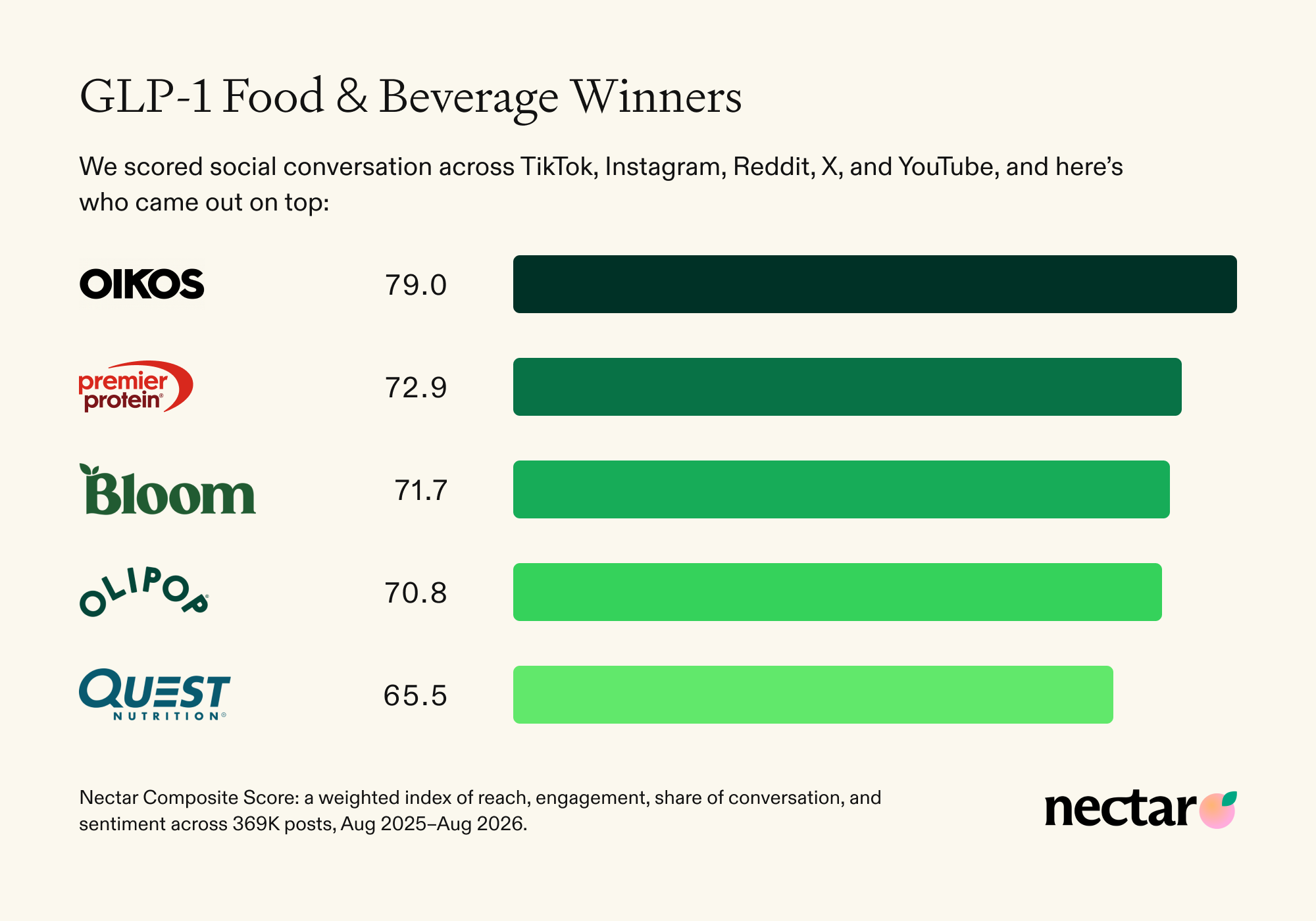
- Retrofitting protein onto an existing SKU is risky. Pop-Tarts and Kraft Power Mac are somewhat cautionary tales, as many of their top organic responses were critical. The product mechanism has to convincingly meet the consumer need, such as Oikos Fusion.
- Showing up in hauls is crucial. The GLP-1 shopping haul format is the biggest earned-media channel. Top-tier organic posts consistently fall in formats like “What I Eat In A Day” or retailer hauls with multiple brands per video. Get on the shelves, and get on the list.
- Own one job to be done. Our results suggest that GLP-1 users are shopping for specific needs: Oikos and Premier Protein for protein, Olipop for fiber, Bloom for electrolytes and hydration. The winners pick a lane and win it, instead of trying to be a “GLP-1” brand.
Weight management
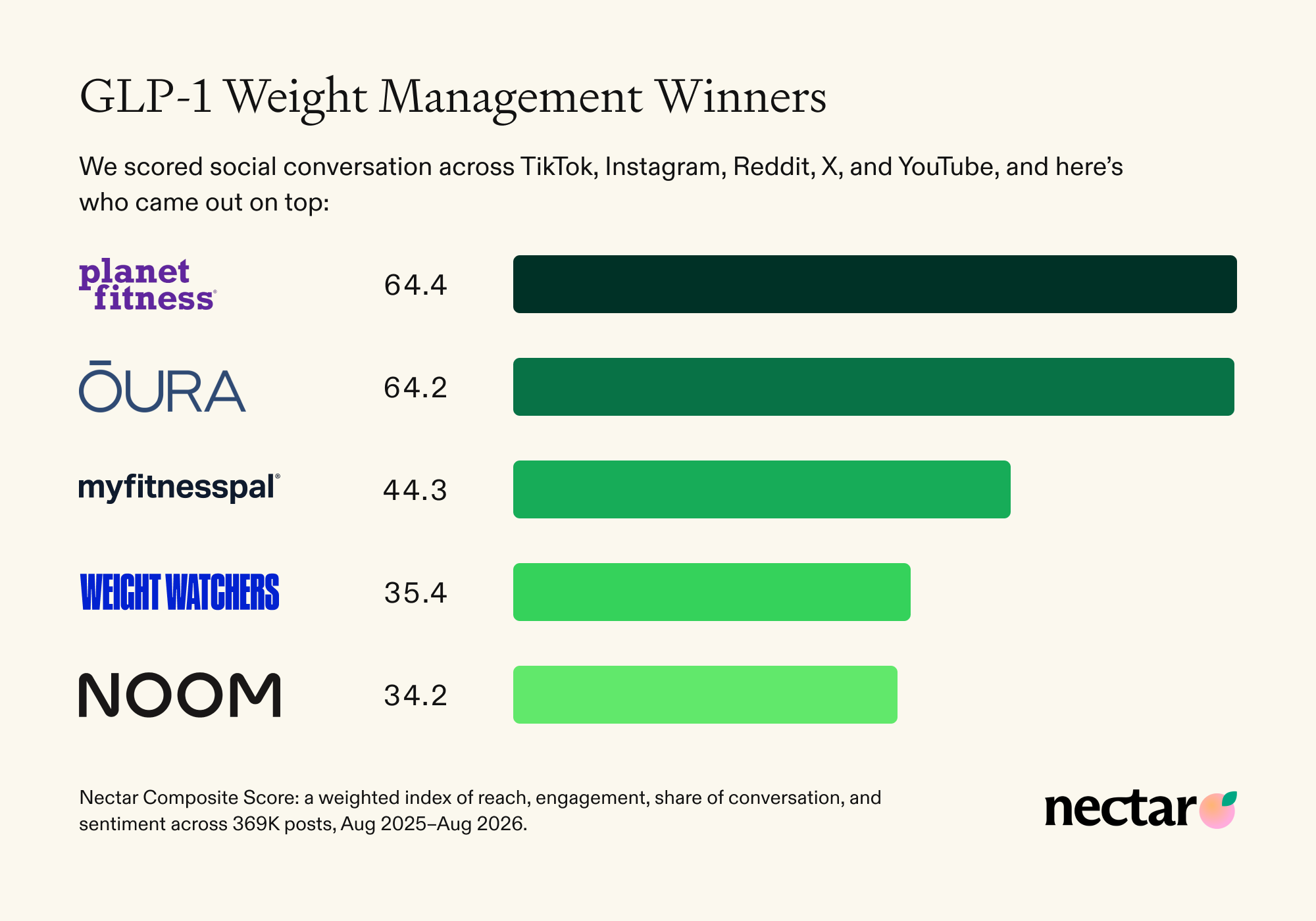
- You have to show up in GLP-1 stacks. Creators assemble multi-tool “stacks” (MyFitnessPal + Oura + protein + electrolytes + supplement) and tag brands unpaid, but only brands already visible in the conversation. This audience is actively shopping for tools to support their GLP-1 journey, so if you’re not in the stack, you’re invisible.
- Ship a dedicated feature. Oura earned its place in GLP-1 content first, showing up in formats users were already making (“things worth my money,” what-I-eat-in-a-day, etc.) Then they built for the behavior, shipping GLP-1 insights alongside a LillyDirect partnership. Product foundation plus distribution, in that order: meet the audience in their formats, then ship the functionality that locks them in.
- Reddit is where the users are. Our data shows that ~60% of actual patient conversation happens on Reddit. Oura built a moat to emulate: r/ouraring generates ~6x more posts than Whoop’s community on only 1.5x the subscribers, and carries the highest GLP-1 co-mentions of any brand-owned community in its peer group. A credible presence here costs nothing and outranks raw reach, because it’s where actual users talk.
Beauty
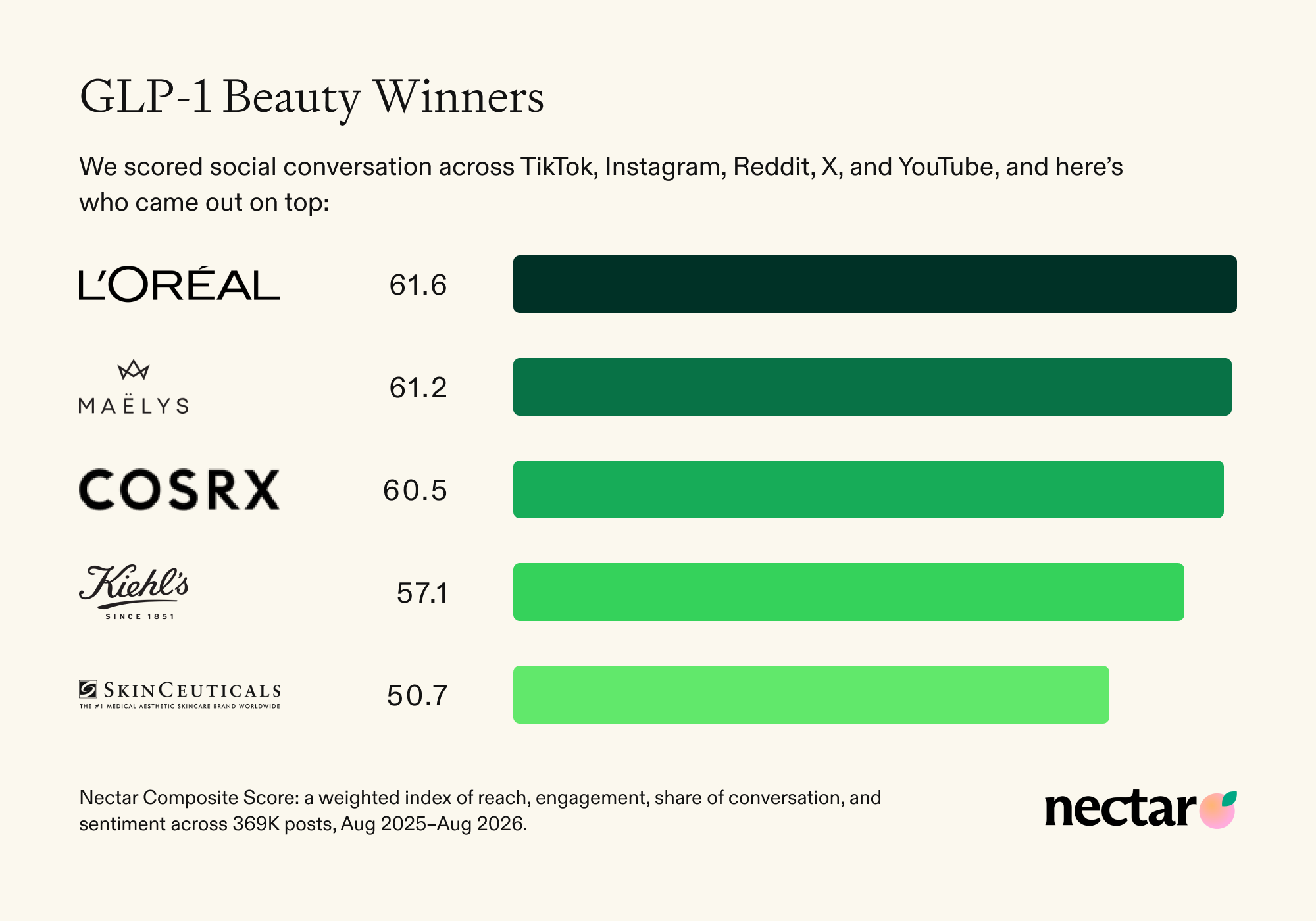
- Haircare is the category’s whitespace. Hair loss is one of the most legitimate problems GLP-1s cause, yet no hair brands are dominating socials. The most credible unmet need in the companion economy is sitting unclaimed. Haircare’s distribution engine on socials is the salon creator, an expert channel that is a double-edged sword, as they can simultaneously verify or audit GLP-1 claims. As brands enter the space, they must ensure their product and clinical claims are up to snuff.
- Go broad for discovery, explicit for conversion. Maelys frames its toning line as general body care, picking up high-reach weight-loss creators alongside GLP-1 users, while its own site bundles the same products as a “GLP-1 Journey” for anyone arriving with the specific problem. Sales are up 85%, and engagement is 7%, among the highest in the dataset.
- Listen to your audience. Brands get mentioned in GLP-1 stacks before even making dedicated product lines, a clear signal from consumers for new product development. Brands looking to enter the space should first check what organic product signals already exist. Do your users actually need you to make GLP-1 companion products?
Retail
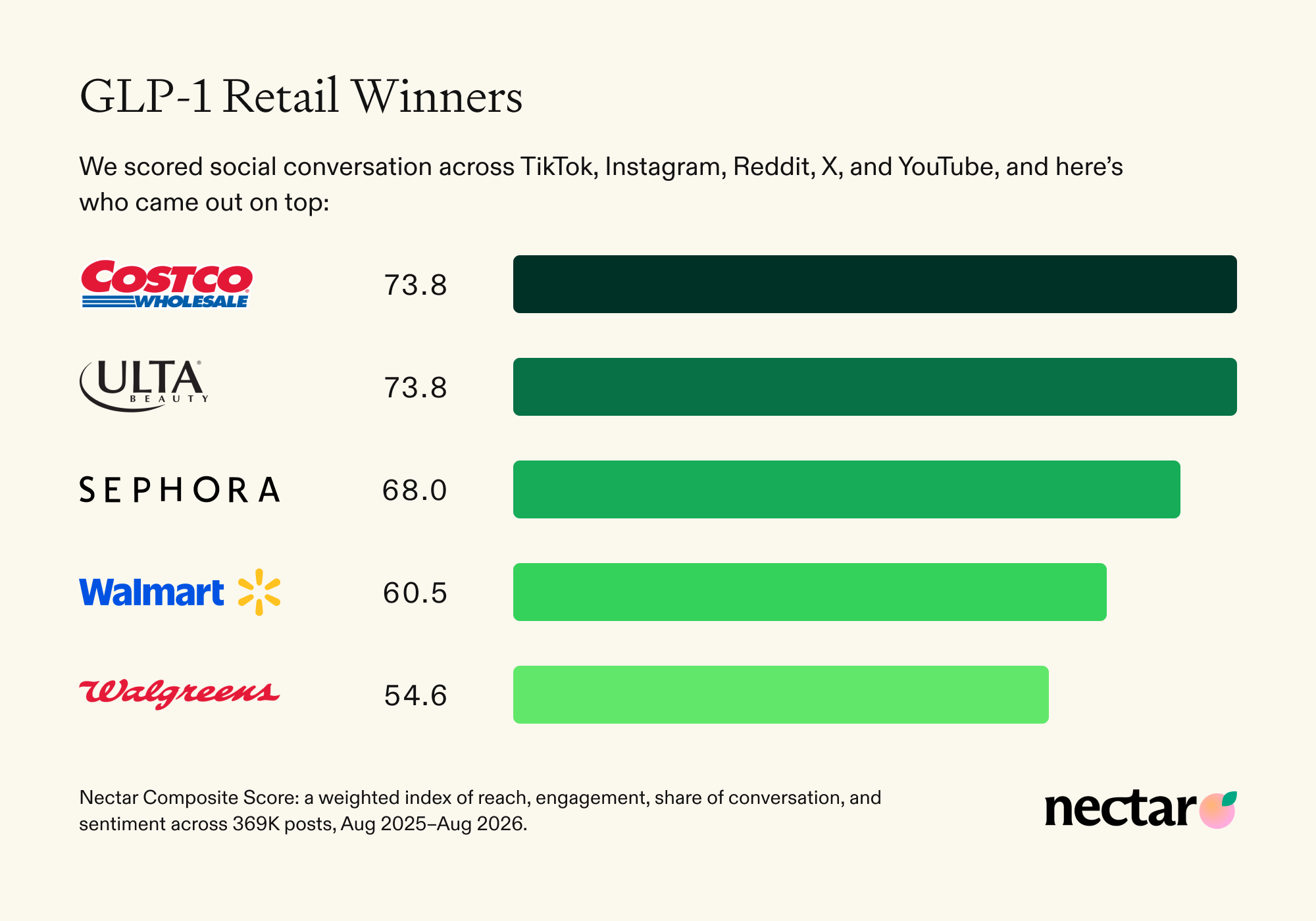
- Design the store to serve as the set. Costco offers GLP-1 prescriptions and stocks companion products but has never mentioned the drugs in owned content. Creators carry it instead, with the “GLP-1 Costco haul” as the format. The retailer’s job is to be the setting where high-engagement formats get filmed, but to do so, retailers must stock the right products and dedicate enough shelf space to earn the haul format.
- Exclusives turn shelf space into story. Sephora, having exited supplements, is running the same play one category over as launch partner for Kiehl’s CollaShot. It’s what Ulta did with Maelys: name the need publicly (hair loss, skin elasticity), lock an exclusive, and let creators film the shelf. Merchandising becomes earned content.
- The haul format skews female for now. In our dataset, the top GLP-1 haul creators are overwhelmingly women, even though the GLP-1 population itself is far more balanced. That gap suggests an under-served audience. Retailers thinking about the next phase of GLP-1 content should consider what the male-coded version of the haul looks like and how to stock their shelves accordingly.
Telehealth
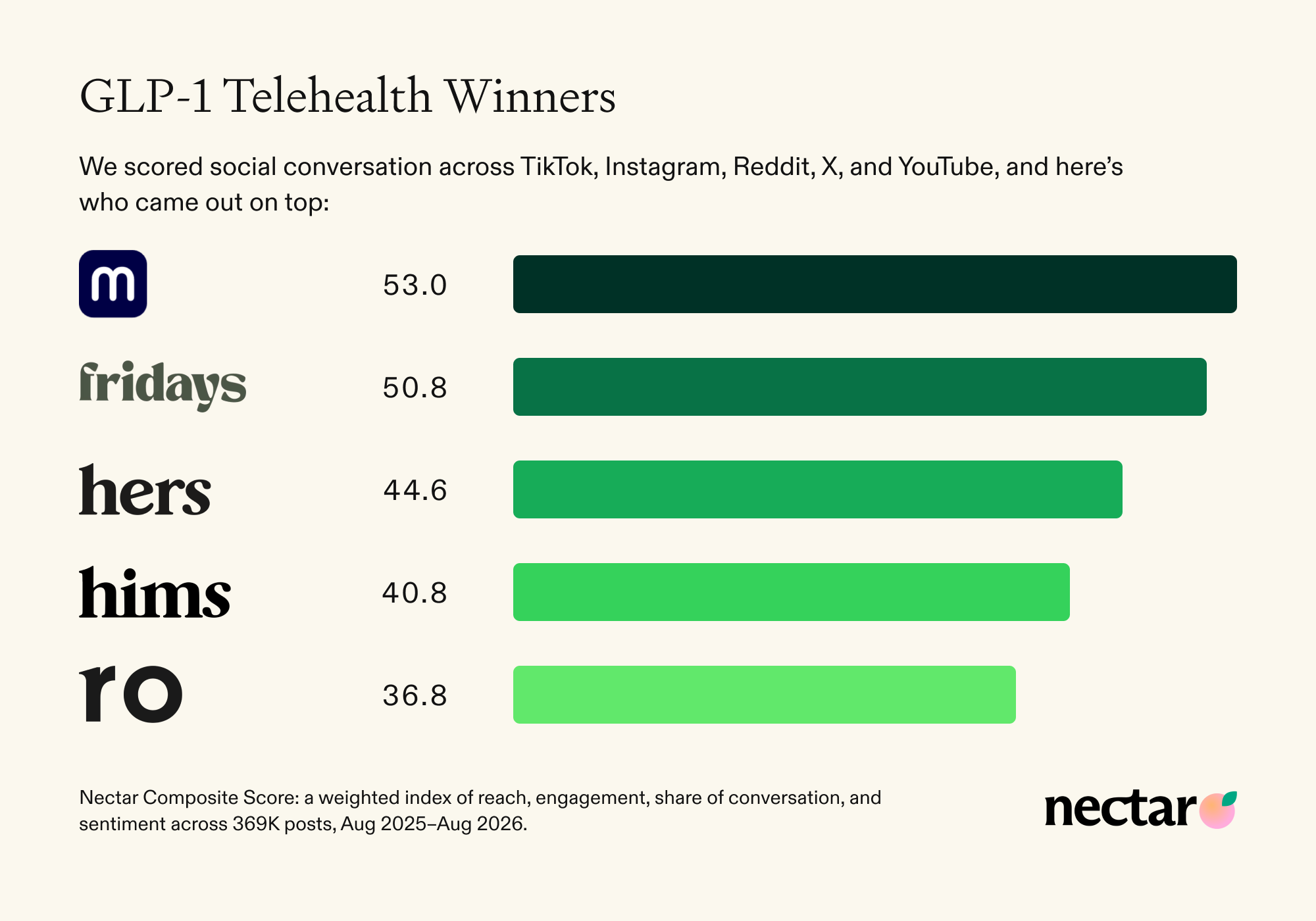
- Volume is misleading, whereas engagement is very important. Hims has 60% more posts and 4x the views of Hers yet scores lower, and Ro has 3x Mochi’s views and finishes last. Why? Views can be a vanity metric. Hers earns 9x the engagement per tagged post that Hims does. Tracking only reach misses the importance of engagement and conversion.
- Price is a strong indicator of negativity. Ro falls in our rankings because their sentiment share is one of the lowest in our dataset. Ro’s sentiment is low because cost and access are lightning rods. Brand equity in telehealth is set by pricing and coverage decisions, no matter the celebrity endorsements and creative.
Emerging categories: the biggest opportunities
Mental health
- The largest whitespace in the companion economy is the feeling. ~46K posts and 1.2B views sit in the mental-health conversation around GLP-1s. Conversations like the flattened-mood narrative now travel under “Ozempic personality.” Brands have spent two years building for the physical side effects. Patients are increasingly posting about how the drug makes them feel, and no consumer brand owns any part of that.
- The opening is aftercare. The lane is what plugs in after the injection: guided journaling for identity reconstruction, therapist matching trained specifically on GLP-1 emotional side effects, group programming for “the person I was before the shot.” Moment, Recess, BetterHelp or Talkspace could each move here without reformulating anything, which is what makes this a high-margin and defensible position.
Oral care
- Oral care is a major GLP-1 side effect that is underserved. ~13K posts and 500M views, with dry mouth, breath changes, and enamel sensitivity all surfacing organically and no brand attached to any of it.
- Name it, then let dentists say it. Dentist-creators are already publishing GLP-1 side-effect explainers unpaid, which makes expert credibility the cheapest distribution available in the category. Colgate, Sensodyne, Biotène or TheraBreath could own dry mouth caused by GLP-1s the way Maëlys is currently fighting to own loose skin. The same caution applies here as in haircare: an expert channel will repeat your language and stress-test your claim in the same video, so name the condition before you claim to fix it.
Pharmaceuticals and the grey market
The most consequential brand competition in this category arguably isn’t between the companion products, but rather the drug names themselves. Interestingly, the competition isn’t going the way share of voice would predict. Novo dominates the conversation and is losing the market. Meanwhile, two of the fastest-growing products people are discussing can’t be bought at a pharmacy at all.
Novo is winning the volume war and losing the value war
- Ozempic and its siblings hold 62% of the two-company brand conversation.
- Excess share of voice theory says that should drive growth.
- Yet Novo has lost 7.3 points of market share in six quarters.
The reason: Ozempic owns the damage vocabulary
Across 165,000 brand-mentioning posts, we tracked every side-effect coinage (“face,” “butt,” “baby,” “personality,” “teeth”) attached to a drug name:
- Ozempic accounts for 97.4% of them.
- It carries damage language at 17x the rate of every alternative combined.
- Even Mounjaro posts reach for “Ozempic face” more than “Mounjaro face” (100 to 38).
- Wegovy, same molecule and maker, carries harm attachment at 1/60th the rate.
Meanwhile, the aspirational vocabulary flows the other way:
- “Results,” “journey,” and “transformation” attach to Zepbound at 15x Ozempic’s rate.
- Lilly’s brands collect the category’s benefits. Ozempic absorbs its costs.
This is genericization in reverse
Ozempic became the Kleenex of the category. But the category it names is now defined in public by its harms — facial wasting, mood changes, and broader side-effect anxiety. That shorthand shows up in posts about competitor drugs, from patients describing their own bodies, on every platform we measured.
The strategic implication
When a meaningful share of your share of voice is share of blame, out-talking your competitor stops predicting growth and starts explaining decline. Other factors are at play (efficacy, access, pricing), but the data is clear: the way people discuss Ozempic is a material driver of Novo’s decline, not a byproduct of it.
Two of the biggest products in the GLP-1 conversation can’t be bought at a pharmacy
- Retatrutide is a Lilly molecule still unapproved anywhere in the world.
- Compounded tirzepatide is a copy of Zepbound made outside Lilly’s supply chain.
- Together they hold 10.9% of 2026 brand conversation.
The figure is a floor, not a ceiling. Much of this conversation is written in “algospeak,” an internet language built to avoid algorithmic blacklisting — “r3ta,” “ret33,” and, most memorably, “ratatouille.” We built a lexicon of the community’s evasion vocabulary, validated each term against real posts, and counted ambiguous ones like “reta” only alongside GLP-1 context. It is impossible to capture all of this algospeak, which is why we believe this number is a floor.
On Reddit, the unapproved molecules out-earn the approved ones
- r/Retatrutide, devoted to a molecule with no approval anywhere, has 162,000 members. In contrast, r/Ozempic, named for the most famous drug on earth, has 146,000.
- r/Retatrutide produces roughly twice the posts and earns 2.4x the upvotes.
- r/tirzepatidecompound ranks second among all GLP-1 subreddits by attention, ahead of every branded community except Zepbound’s own.
On the platform where patients actually discuss their treatment, unregulated product is drawing some of the highest engagement in the category.
GLP-1 users watch TikTok, but they talk on Reddit
We wanted to isolate the conversation of people actually talking about their use of GLP-1s, rather than commentary about the drugs, or even lifestyle content around the drugs. To do so, we identified posts with first-person treatment markers, such as “injection day”, titration and dose language, the community’s weight shorthand, insurance conversation, etc. We found that despite holding just 13.6% of our total GLP-1 conversation volume, Reddit is where 60% of all user-flagged posts live.
Across the GLP-1 universe sits another 1.6 million user comments, and they carry thousands of brand mentions. Here is just a small sample of what these kinds of comments look like, unprompted and unpaid:
I get them at Costco for a better price. Between the Oikos protein shakes I prefer, Gruns, and my shot copay, it’s a lot.
Clean Simple Eats protein powder is actually really tasty (this coming from someone who gags at the taste of Fairlife and I know everyone else loves it!)
my first few days after my first shot my sleep was shredded and my Oura ring said my body was showing signs of [stress].
Had to switch to Walgreens due to insurance and now I have it on auto fill. They always have it ready early in the week that I take my last shot.
i get mine through GoodRx ($39/month) and filled by Amazon Pharmacy.
That’s competitive intelligence, purchase-intent signal, and word-of-mouth marketing happening in public, for free, and in the context where the user’s situation is fully known. The brand being named is answering actual community needs. If brands want to know how to capitalize on the change in consumer behavior caused by GLP-1s, Reddit is the platform with which to start.
Five moves for Monday morning
- Audit your Reddit presence in the top three patient subreddits (r/Zepbound, r/Ozempic, r/Mounjaro). If your brand is already being organically mentioned, you have a signal. If it’s not, that’s your first job.
- Get on the shelf and get on the list. The “What I Eat In A Day” and haul formats are the biggest earned-media channels in the category. Retail placement is the entry ticket.
- Own one job to be done. Don’t try to be a GLP-1 brand. Own protein, or fiber, or electrolytes, or scalp health, or skin elasticity and let the category find you.
- Let creators carry the language. Proximity without the claim is the winning position. Legal exposure grows with every explicit “GLP-1 friendly” you print.
- Watch the whitespace. Mental health, oral care, sulfur burps, NAD depletion, and hair loss are the largest under-served needs. The first credible clinical claim in any of them wins the sub-category.
Turn your community into a growth engine.
See how AI-powered workflows can help you respond quicker, sell smarter, and scale your social presence, without the chaos. Book a demo to get a closer look.